Process firstThe architecture begins with real work.
People accountableApprovals and boundaries stay visible.
Designed for EuropePrivacy and clear rules from the outset.
The next step
From isolated AI tools to an intelligent organisation.
Many businesses already use individual AI tools. The greater opportunity appears when AI works inside a process with knowledge, systems and people.
We do not just talk about AI. We integrate it into real business operations with traceable controls and a clear operational purpose.
01Understand processes
We look at how work happens today and where time is being lost.
01Understand processes
We look at how work happens today and where time is being lost.
02Use company knowledge
Your approved documents help answer questions and complete tasks.
02Use company knowledge
Your approved documents help answer questions and complete tasks.
03Connect systems
Your tools exchange information, reducing manual copying.
03Connect systems
Your tools exchange information, reducing manual copying.
04Take on tasks
Recurring tasks are handled automatically, such as sorting documents.
04Take on tasks
Recurring tasks are handled automatically, such as sorting documents.
05Share the work
Several digital helpers handle individual steps and pass results on.
05Share the work
Several digital helpers handle individual steps and pass results on.
06Involve people
When something is unclear or an important decision is needed, your team takes over.
06Involve people
When something is unclear or an important decision is needed, your team takes over.
How AI works in the business
Do not just talk about it. Make it visible in the workflow.
Two essential building blocks show how AI becomes a controllable business process.
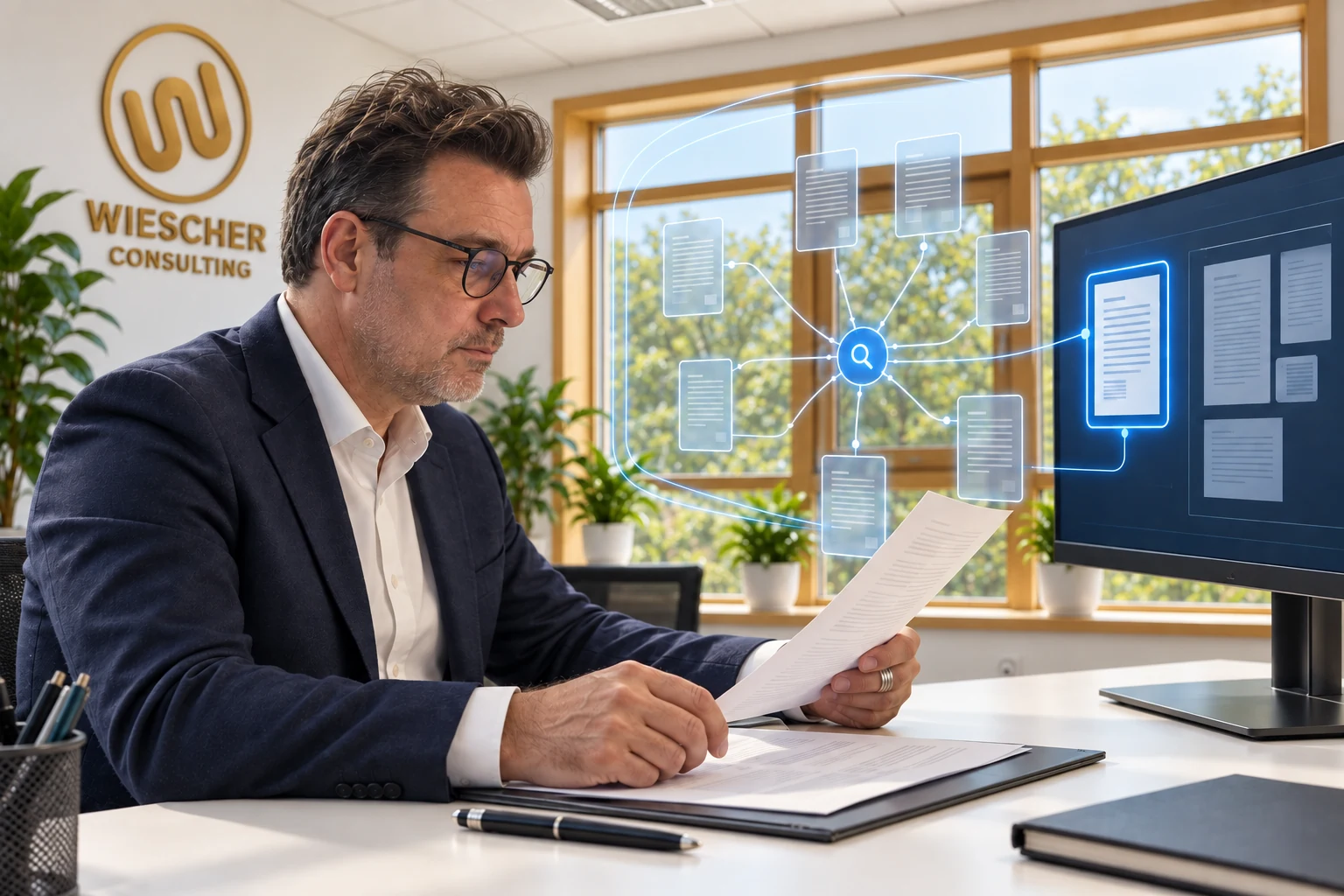
AI-generated scene based on our office premises.
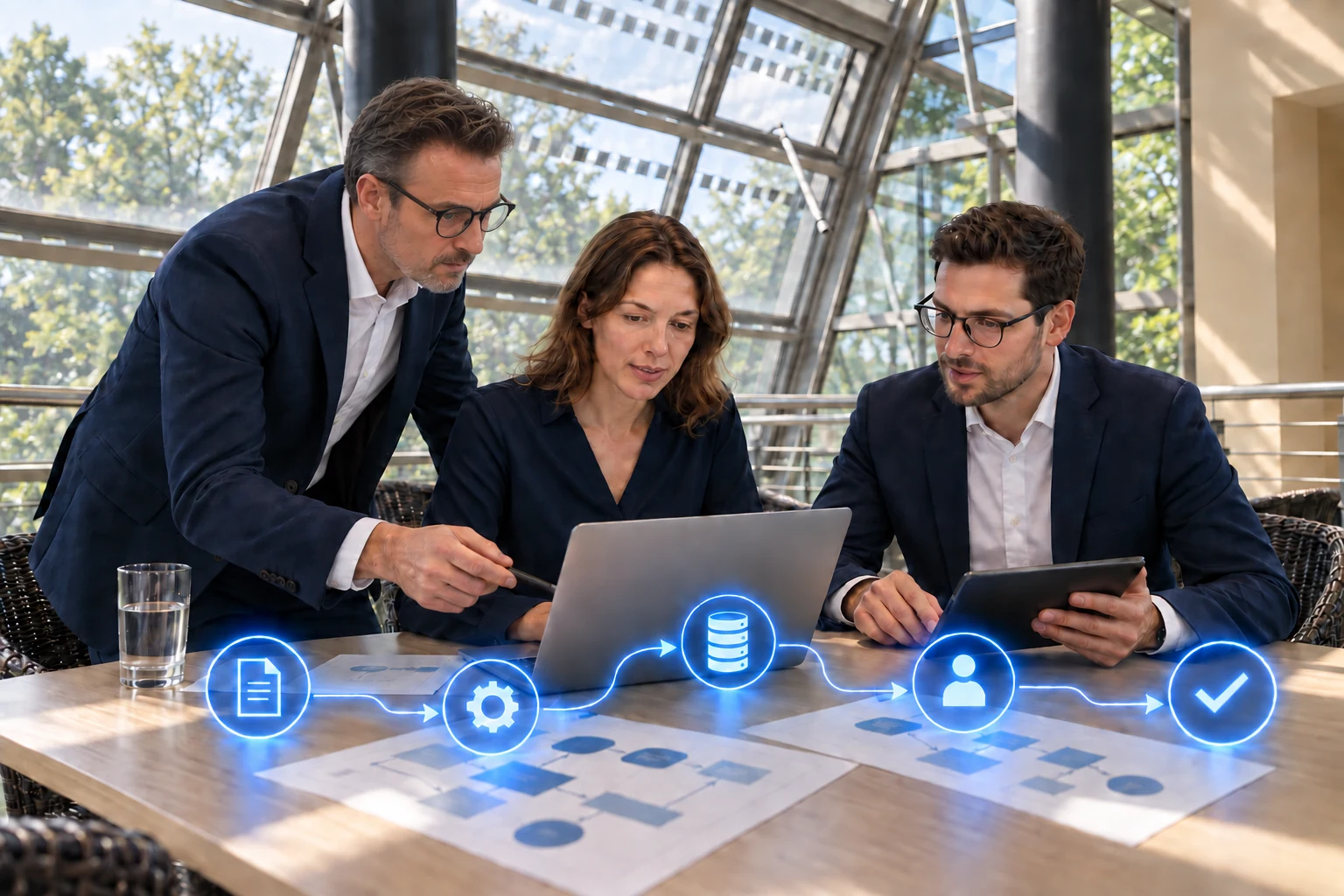
Process automation
From intake to approval: AI works inside the process.
Production automation connects documents, knowledge and existing systems. It moves work forward and involves people deliberately for exceptions and critical decisions.
Knowledge becomes a dependable working foundation.
AI should not simply see everything. Curated sources, role-based access and visible provenance make knowledge usable for answers and agent work under clear control.
The essential questions before a first AI project.
What is an AI employee?
An AI employee is a defined digital role for bounded tasks. It can use approved knowledge and tools, hand work over and escalate exceptions to people. The term does not describe a natural person or an employment relationship.
What distinguishes an AI agent from ChatGPT?
A conversational system typically responds to input. An agent can derive several steps from an objective, use approved functions and process work until handover. That ability to act requires roles, permissions and stop conditions.
Which processes can be automated with AI?
Recurring, information-rich workflows with clear objectives and reviewable outcomes are strong candidates. Unambiguous rules are often better handled conventionally; AI can help with variable language, documents, research and contextual preparation.
Can AI access our internal data?
Yes, when access is necessary for the task, technically supported and explicitly approved. Curated sources, role-based rights and data minimisation are appropriate. Not every system or document should be available by default.
How are AI agents controlled?
Through clear roles, minimum permissions, allowed actions, approval gates, escalation paths and expert quality review. Critical steps can be blocked until an accountable person decides.